
California Housing Market: Forecast and Trends 2025-2026
If you’re thinking about buying or selling a home in California, you’ve probably got a million questions buzzing around your head. Here’s the quick answer: California’s housing market saw a modest rebound in August, with home sales inching up thanks to slightly lower mortgage rates and more stable prices. This small shift is giving a glimmer of hope after a somewhat bumpy ride.
The latest report from the California Association of Realtors (C.A.R.) paints a picture of a market that’s still finding its footing, but with some encouraging signs on the horizon. Let’s dive into what this all means for you.
California’s Housing Market Trends 2025
The August Rebound: A Breath of Fresh Air?
After a few months where sales numbers were drifting downward, August showed a slight uptick. We saw about 264,240 existing single-family homes sold on a seasonally adjusted annualized rate. That’s a little more than July’s 261,820 and just a hair less than last August’s 264,640. While it’s not a massive surge, any positive movement is welcome news for those who have been waiting on the sidelines.
One of the biggest factors here? Mortgage rates. When rates dip, even by a little, it makes buying a home more affordable for more people. C.A.R. noted that August saw mortgage rates hit a 10-month low. This drop, combined with prices holding steady, seems to have coaxed some hesitant buyers back into the game.
What’s Happening with Home Prices?
This is where things get really interesting. For three months leading up to the summer, we saw home prices in California drop a bit year-over-year. But in August, that trend reversed. The statewide median home price reached $899,140. That’s up 1.7% from July and 1.2% higher than where we were last August.
This stability is a crucial sign. When prices aren’t plummeting, it can make buyers feel more confident that they’re making a solid investment. As C.A.R.’s Chief Economist, Jordan Levine, pointed out, the market seems to have found a “short-term balance between supply and demand.” This balance is what we need to see for a healthy market to continue. If mortgage rates stay low or go even lower, we might just see positive price growth stick around.
Regional Differences: California is Not One-Size-Fits-All
It’s super important to remember that “California housing market” is a huge umbrella. What’s happening in one county might be completely different from what’s happening just a few hours away.
- Sales by Region:
- Only two major regions saw year-over-year sales increase: the Far North (up 2.9%) and the Central Coast (up 1.6%). These areas are often more affordable and attract buyers looking for a different lifestyle.
- The San Francisco Bay Area experienced the biggest drop in sales, falling 4.1%. This is often due to its already high price points, making it tougher to enter the market.
- Southern California and the Central Valley also saw slight dips.
- Price Changes by Region:
- Three out of the five major regions saw prices go up compared to last year. The Central Coast led the pack with a 6.3% increase.
- The San Francisco Bay Area saw prices climb by 2.8%.
- Southern California had a mild increase of 1.2%.
- The Far North and Central Valley saw prices dip slightly.
This regional variation highlights why getting local expert advice is so important. Your neighborhood real estate agent will have the pulse on your specific area.
Looking Deeper: County-Level Insights
We can get even more granular. At the county level, things get even more dramatic.
- Sales Growth: Many counties saw significant jumps in sales. Think about Mariposa County, which saw an incredible 81.8% increase in sales year-over-year! Other counties like Lassen (46.7%) and Kings (36.1%) also showed impressive gains.
- Sales Declines: On the flip side, some counties saw sales drop significantly. Yuba County experienced a 35.3% decrease, while Calaveras (-31.3%) and Tehama (-24.0%) also saw notable declines.
- Price Growth: Counties like Santa Barbara saw a whopping 32.6% jump in median home prices. Monterey (20.8%) and Trinity (10.7%) also saw strong price appreciation.
- Price Declines: On the other end, Del Norte County saw its median price drop by 21.7%, with Mendocino (-17.3%) and Plumas (-12.3%) also experiencing significant declines.
These numbers tell a story of localized markets, each with its own set of buyers and sellers, economic drivers, and housing inventory.
Inventory and Time on Market: What Does It Mean for You?
The Unsold Inventory Index (UII), which tells us how many months it would take to sell all the homes currently on the market, increased to 3.9 months in August. This is up from 3.7 months in July and 3.2 months a year ago.
What does this mean? It suggests that there’s a bit more breathing room for buyers. More inventory generally means less competition, and potentially more room for negotiation. However, the pace of inventory growth is slowing down compared to earlier in the year. This could signal that as we head into the slower fourth quarter, supply might not increase as much as it did previously. For buyers, this means staying alert and ready to make a move when the right property appears.
The time it takes to sell a home also tells us a story. In August, it took an average of 31 days to sell a California single-family home. This is up from 22 days last August. Longer days on market can be a sign that buyers have more choices and aren’t feeling the extreme pressure of a red-hot market.
The Sales-to-List Price Ratio: A Seller’s or Buyer’s Market?
The sales-to-list price ratio was 98.3% in August. This means that, on average, homes sold for slightly below their asking price. Last August, this ratio was at 100%, indicating homes were selling at or above list price. For sellers, this means you might need to price your home competitively. For buyers, it suggests you might have a slightly better chance of negotiating the final price.
My Take: A Market in Transition
As someone who works in and observes this market closely, I see August’s data as a positive step, but not a complete turnaround. The slight increase in sales and stabilization in prices are definitely good signs. The fact that mortgage rates are showing a downward trend is a crucial factor that could drive more activity in the coming months.
However, it’s not a free-for-all for buyers just yet. Median prices are still high, and while inventory is up year-over-year, the pace of inventory growth is slowing. This means that well-priced homes in desirable areas will likely still attract multiple offers.
For sellers, the key is still to be realistic with pricing and to present your home in the best possible light. For buyers, patience and preparedness are your best friends. Keep an eye on interest rates, stay informed about local market conditions, and be ready to act when you find the right home.
California Housing Market Forecast 2025-2026
The California‘s housing market forecast for 2025 anticipates a rise in both home sales and prices, with the median home price potentially reaching $909,400. This positive outlook is fueled by a projected improvement in housing supply and a more favorable interest rate environment, attracting more buyers and sellers back to the market.
A Brighter Outlook for California’s Housing Market
Over the past few years, the California housing market has been a roller coaster ride. We’ve seen dramatic swings in interest rates, a shortage of homes available for sale, and a significant impact on affordability. However, based on recent data and projections, it seems that we are entering a period of relative stability and potential growth.
The California Association of Realtors (C.A.R.) has released its 2025 forecast, and the general consensus is optimistic. They project that existing single-family home sales will increase by 10.5% in 2025, reaching 304,400 units. This increase is a significant shift from the recent downward trends caused by high-interest rates and limited inventory.
Factors Driving the California Housing Market Forecast 2025
Several key factors are contributing to this projected growth in the California housing market:
- Lower Interest Rates: The forecast predicts that the average 30-year fixed-rate mortgage will decline from 6.6% in 2024 to 5.9% in 2025. This reduction in borrowing costs will make it easier for buyers to qualify for a mortgage and could spark increased demand. I feel it’s a great opportunity for first-time homebuyers to enter the market as it will bring the rates closer to pre-pandemic levels.
- Improved Housing Inventory: Although the housing supply will still be below historical averages, there’s an expectation of a moderate increase in active listings. Homeowners who were hesitant to sell due to the “lock-in effect” (when homeowners are hesitant to sell due to existing low interest rates) may be more inclined to list their homes as interest rates decrease and offer more selling flexibility.
- Returning Buyers and Sellers: The combined effect of lower interest rates and a less restrictive inventory situation will likely lead to increased activity from both buyers and sellers.
- Continued Demand: While the rate of price growth is projected to moderate, the demand for housing in California remains high. This strong demand, coupled with limited inventory, will continue to push prices upward.
The California Median Home Price Forecast
The C.A.R. forecast predicts the California median home price will increase by 4.6% to reach $909,400 in 2025. This is following a projected 6.8% increase in 2024 to $869,500 from the 2023 level of $814,000. While this signifies continued price growth, it’s important to note that the pace of this growth is anticipated to be slower than in recent years.
My personal take on this is that the housing shortage will continue to impact affordability, even with the predicted increase in inventory. This continued shortage creates a competitive environment that will keep prices elevated in the majority of California’s cities.
Housing Affordability: A Persistent Challenge
Housing affordability is a crucial issue for California residents, and the forecast suggests that it will remain a concern in 2025. The affordability index is projected to stay at 16%, meaning that the median-priced home is only affordable to 16% of households. It’s a concern that needs to be addressed.
Economic Outlook and Impact on the California Housing Market
The California housing market is not isolated from broader economic trends. The forecast anticipates a slight slowdown in the U.S. and California economies in 2025.
- GDP Growth: The U.S. GDP is projected to slow to 1.1% in 2025, compared to 1.9% in 2024.
- Job Growth: California’s nonfarm job growth is expected to decline to 1.1% in 2025 from 1.5% in 2024.
- Unemployment Rate: California’s unemployment rate is anticipated to tick up to 5.6% in 2025, compared to a projected 5.4% in 2024.
However, the economic outlook is still considered relatively healthy, which should provide support to the housing market.
California Housing Market Forecast 2025: Historical Data
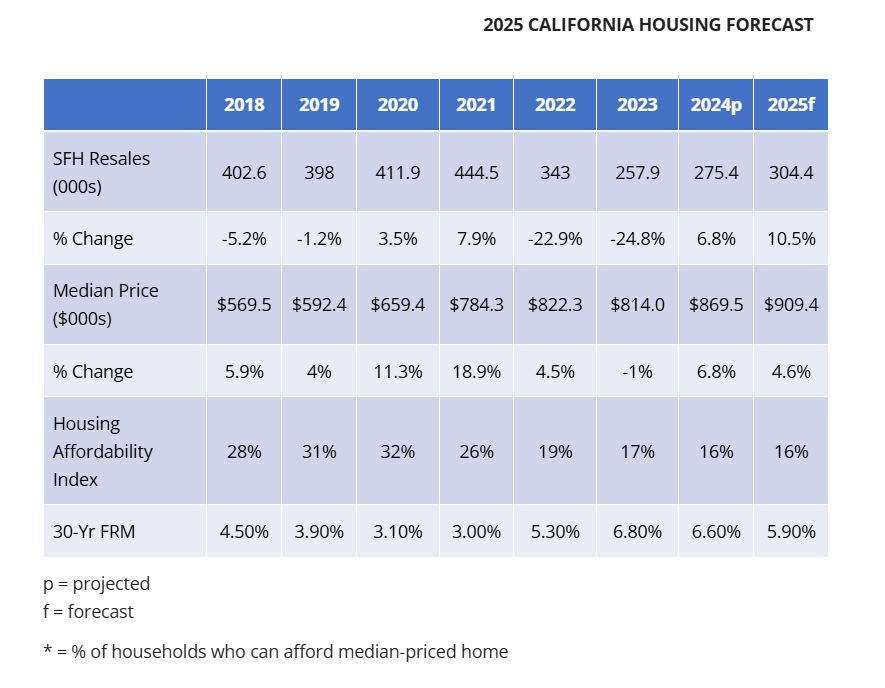
Here is a table that outlines the key metrics of the California housing market over the past few years and the projections for the coming years.
| Year | SFH Resales (000s) | % Change | Median Price ($000s) | % Change | Housing Affordability Index | 30-Yr FRM |
|---|---|---|---|---|---|---|
| 2018 | 402.6 | -5.2% | 569.5 | 5.9% | 28% | 4.50% |
| 2019 | 398 | -1.2% | 592.4 | 4% | 31% | 3.90% |
| 2020 | 411.9 | 3.5% | 659.4 | 11.3% | 32% | 3.10% |
| 2021 | 444.5 | 7.9% | 784.3 | 18.9% | 26% | 3.00% |
| 2022 | 343 | -22.9% | 822.3 | 4.5% | 19% | 5.30% |
| 2023 | 257.9 | -24.8% | 814.0 | -1% | 17% | 6.80% |
| 2024p | 275.4 | 6.8% | 869.5 | 6.8% | 16% | 6.60% |
| 2025f | 304.4 | 10.5% | 909.4 | 4.6% | 16% | 5.90% |
The California housing market forecast for 2025 indicates a potential rebound in both sales and prices. The projected improvement in inventory and lower interest rates is likely to attract more buyers and sellers. While the pace of price growth is expected to slow down, the underlying demand and limited supply conditions will likely continue to put upward pressure on home prices.
I believe that 2025 could present both challenges and opportunities for those looking to buy or sell in the California housing market. It’s crucial to stay informed about current market conditions and to consult with real estate professionals to make well-informed decisions.
What to Expect in the California Housing Market in 2025?
1. Mortgage Rates Will Play a Key Role
- The recent dip in interest rates has been a breath of fresh air for buyers.
- While no one can predict the future with certainty, most experts believe rates will remain relatively stable for the rest of the year, hovering around the 6-7% range.
- This could incentivize more buyers to enter the market, especially if prices continue to moderate.
2. Inventory Will (Slowly) Improve
- The increase in active and new listings is a positive sign.
- However, don’t expect a sudden surge in inventory. California has a chronic undersupply of housing, and it will take time to bridge the gap.
3. Price Growth Will Continue, But at a Slower Pace
- Double-digit price appreciation is likely a thing of the past (for now, at least).
- Most analysts predict more sustainable, single-digit price growth for 2025.
- Don’t expect a crash – the fundamentals of the California economy remain strong, supporting continued demand for housing.
4. Regional Variations Will Persist
- As always, California’s vastness means there’s no one-size-fits-all trend.
- The Bay Area, with its robust tech sector, will likely continue to see strong demand, even with some cooling.
- Coastal communities, highly desirable for their lifestyle, will also remain competitive.
link