NREL Researchers Survey the State of Smart Charge Management Nationwide | News


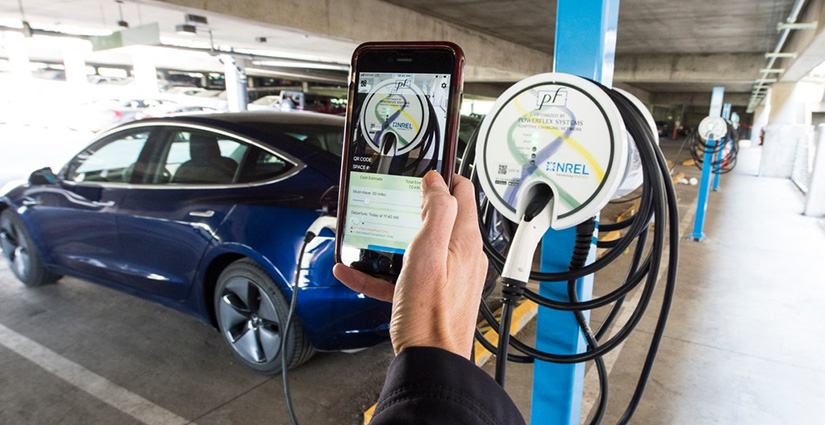
Researchers from the National Renewable Energy Laboratory and Lawrence Berkeley National
Laboratory broke new ground by surveying the national state of smart charge management
strategies. Photo by Dennis Schroeder, NREL
Smart charge management—intelligently managing the flow of electricity that charges
electric vehicles (EVs)—can have incredible benefits for drivers, utility companies,
governments, and fleets. Yet smart charge management strategies have not been widely
deployed nationwide.
In response, two national laboratories, the National Renewable Energy Laboratory (NREL)
and Lawrence Berkeley National Laboratory (LBNL), broke new ground by surveying the
national state of smart charge management across the United States.
In a new report published with the Department of Energy’s (DOE’s) Vehicle Technologies
Office (VTO), the two laboratories detail their major findings from reviewing more
than 100 managed charging programs nationwide and conducting over 40 interviews with
utility companies and stakeholders.
Striking a Balance Between Cost, Efficiency, and Grid Stability
The report, titled “Survey and Gap Prioritization of U.S. Electric Vehicle Charge Management Deployments,” established a baseline understanding of the smart charge management programs and
technologies implemented by U.S. utility and EV companies.
“EV adoption rates are rising nationally, but we’re seeing considerable differences
in readiness levels among utilities,” said LBNL’s Doug Black, who served as the overall
lead of the report. “We wanted to establish a baseline to understand the current state
of smart charge management and then see what factors might be slowing the implementation
of managed charging programs.”
EV charge management can be as simple as a driver restricting their charging to certain
hours—such as during the lowest-priced period of a time of use (TOU) rate published
by a utility company, which varies the cost of electricity for different periods of
the day.
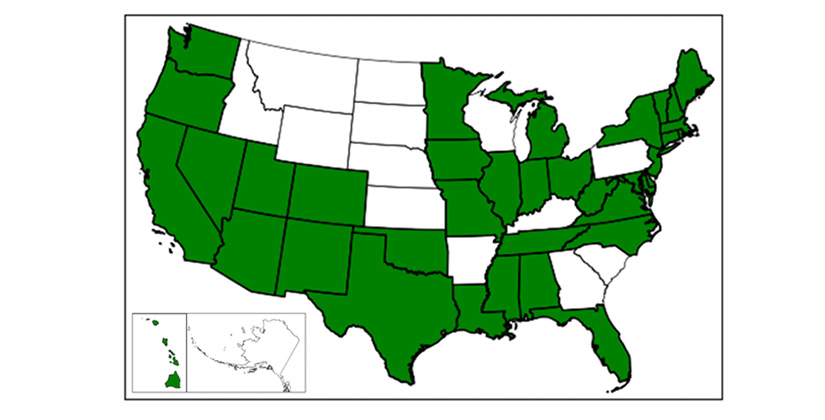
Not every state has charge management deployments—only those colored green in the
above chart. Image from Lawrence Berkeley National Laboratory
It can also be accomplished dynamically through smart charge management. Smart charge
management is essentially a conversation between a vehicle, charging equipment, and
the grid. During the conversation, the charging needs of the EV—how fast it charges,
based on how much power is available, and at what time that power can be made available—are
negotiated to keep the vehicle battery from demanding too much power from the grid
at once.
By adjusting the level of electricity provided to an EV’s battery at a given time,
smart charge management technologies can prioritize EV charging during times of the
day when there is less demand on the power grid while still ensuring drivers get the
electricity they need. By avoiding “surge pricing” during high-demand times, they
can minimize charging costs. And by lessening peak demand on the grid, these technologies
can even help utilities reduce or defer the costly and time-consuming grid upgrades
they might otherwise need to accommodate accelerating EV adoption.
Yet while smart charge management can solve critical barriers to widespread EV adoption—from
lowering the cost of charging to reducing demand on the grid—researchers found several
pressing areas where advancements in technologies and standard practices are needed
to enable more widespread adoption.
Three key themes emerged from the review:
- Site-level smart charge management is underutilized. Many EV charging sites have capacity limits that can prevent EV adoption; in other
words, they can only provide so much electricity at a time. Programming these charging
sites with smart charge management strategies could rapidly enable greater access
to EV charging and, in turn, wider EV adoption. - Utilities lack the economic data needed to make the business case for smart charge
management investments. Utilities need to understand the costs they might incur if they don’t implement smart charge management strategies. For instance, without managed charging,
they may need to invest in costly grid upgrades to accommodate growing EV adoption.
These data are needed nationwide to help utilities understand the costs they can defer
by deploying smart charge management technologies. - Fragmented vehicle-grid integration standards are preventing widespread smart charge
management deployments. There are no uniformly adopted standards for bidirectional communication protocols,
which allow for electricity to flow between EVs, charging infrastructure, utilities,
and the grid. Moreover, there is no requirement to comply with a standard and no certification
process for manufacturers who might want to use one. This makes it nearly impossible
for vehicle manufacturers to determine how to build smart charge management into their
vehicles. As a result, there is a risk that companies may develop standalone solutions
that do not work for every EV.
Charting the Path to Greater Adoption
In response to their key findings, the report authors recommend solutions for each
gap in smart charge management knowledge, practice, and technology level.

Multiple communication pathways and protocols between EVs, charging infrastructure,
aggregators, buildings, distribution systems, and bulk power transmission systems. Image from Lawrence Berkeley National Laboratory
First, researchers recommend expanding smart charge management field demonstrations—particularly for “constrained distribution systems,” or charging sites with little
additional capacity to generate electricity. These demonstrations can show EV owners
and fleet managers that smart charge management is user-friendly, does not disrupt
vehicle use, and can have financial benefits. They can also show utilities that smart
charge management strategies are reliable technologies that can be counted on when
needed and can be as cost-competitive as traditional charging.
Second, researchers recommend developing dynamic pricing mechanisms for EV charging. A standardized mechanism could communicate electricity prices from the grid to the
customer, within customer sites, and to cloud entities that provide charging optimization
services. This dynamic pricing can help address grid and electricity generation needs
in real time.
Third, researchers recommend creating systems that put the power to automate smart charge management scheduling
in customers’ hands. Many utilities publish TOU rates that vary the cost of electricity over different
periods of the day. But these rate changes alone could lead to problems with too many
EVs charging at the same time. They also do not guarantee that EV drivers will change
their charging practices. Customers need a system that automates their charge scheduling
in response to dynamic rates or direct control signals, while still making sure that
their EV receives the electricity it needs.
Finally, researchers strongly recommended efforts to advance the state of smart charge management standards, communications
hardware and networks, and technologies—with a particular focus on ensuring interoperability between EVs and charging stations.
They also recommend quantifying the market and policy impacts of smart charge management programs, and sharing those results widely, to help accelerate adoption.
“One of our key findings was that both driver and utility confidence in these programs
needs to increase to see wider implementation of smart charge management,” said Nadia
Panossian, an NREL EV charging researcher who led NREL’s contributions to the survey.
“One way to do that is for utilities to share their findings with each other. There
are smart charge management programs across the country showing promising preliminary
results— and in-depth exposure to, and analysis of, those results could help utilities
see what’s possible.”
Learn more about NREL’s sustainable transportation and mobility research and its specific focus on EV charging. And sign up for NREL’s quarterly transportation and mobility research newsletter,
Sustainable Mobility Matters, to stay current on the latest news.
link