Optimizing sustainable and multifunctional management of Alpine Forests under climate change
The methodological study set-up included six major steps: (i) future forest trajectories were simulated under four alternative management strategies and climate change scenarios for the forest enterprise of Val Müstair (Section “Forest growth and management simulations”), (ii) indicators were calculated to assess the important management objectives for BES (Section “Biodiversity and ecosystem services indicators”). The first two steps are in line with23. In addition, (iii) three multi-objective optimization scenarios were defined, reflecting various management objectives (Section “Future management and optimization scenarios”), and (iv) an optimization model was developed and used to assign the management strategies to the stands (Section “Multi-objective optimization model”). Finally, (v) the outcomes of the scenarios were analysed (Section “Analysis of optimization outcomes”).
Case study site
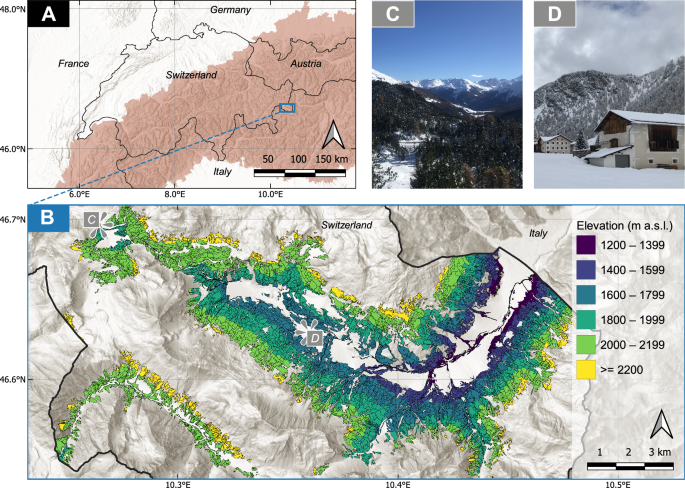
The mountain forest enterprise of Val Müstair was selected as an Alpine case study site (CSS) (Figure 1). Val Müstair is located in the Central Alps of Switzerland in the canton of Grisons (\(46.6^\circ\)N, \(10.4^\circ\)E) and covers a forest area of 4944 ha, ranging from ca. 1200 to 2400 m a.s.l. The forests are dominated by Swiss stone pine (Pinus cembra) and mountain pine (Pinus mugo) at high elevations close to the treeline, and by Norway spruce (Picea abies) and European larch (Larix decidua) at lower elevation ranges. The annual precipitation sum is 800 mm and the mean annual temperature is \(5.3^\circ\)C (mean values over 1981–2010), both measured in Santa Maria (1375 m a.s.l.). Soils have formed on sedimentary material and are relatively shallow and rocky, with low water holding capacities on steeper slopes (soil suitability map of Switzerland, https://map.geo.admin.ch).
Forest management with the principles of CNF for multifunctional purposes has a long history in this region. The main management objectives of the enterprise are protection services, timber production, biodiversity conservation and recreation (see optimization scenarios in Section “Future management and optimization scenarios”). The whole forest area consists of 5786 individual forest stands, some of which have management priorities according to the management plan (Office for Forest and Natural Hazards, 2023) (Fig. 2A). The majority of the forest area is assigned to the protection service (59.6%). Outside of the protection forest, ecologically important mountain pine forests (17.9%) and forest reserves (0.9%) are managed for conservation targets. Around 10.8% of the forest area is managed with priority as habitat for capercaillie (Tetrao urogallus). The remaining forest area (10.8%) has no management priority. While there are some mountain pine forests (6.0% of total area) and capercaillie habitat areas (10.3% of total area) within the protection forest area, the clear priority here is the management of the protection forest.
The recently applied forest management strategies differ across the forest enterprise, depending on the spatial management objectives. While mountain pine forests and forest reserves are mostly not managed, the capercaillie habitat is usually more intensively managed to ensure that the forest structure is sufficiently open, as preferred by this species38.

Location of the case study site in Val Müstair (Switzerland) (A) and elevation of the 5786 individual forest stands (B). Photos of Val Müstair (C & D; \(\copyright\) Simon Mutterer).

(A) The case study site underlies spatial management priorities: forest with protection services and biodiversity and conservation services (reserves, mountain pine forest, habitat for capercaillie). (B) While mountain pine forests and forest reserves are mostly not managed (NO), the capercaillie habitat is usually more intensively managed to guarantee the species’ preferable open forest structures (CNF-HIGH). The remaining areas, including protection forests, are currently under close-to-nature forestry (CNF) management, but NO, CNF-LOW, CNF, CNF-ClimAdapt and CNF-HIGH are considered under the enterprise optimization scenarios (see Section “Future management and optimization scenarios”). For explanations of the CNF management categories, see Section “Forest growth and management simulations”.
Forest growth and management simulations
Forest simulations were performed using the climate-sensitive forest gap model ForClim (version 4.0.1)17,39 over a period of 90 years, from 2010 until 2100. ForClim has already been applied and validated along a large range of environmental conditions in Switzerland17,36,40. Forests stands within ForClim are represented by a composition of 100 patches each equivalent to the size of a single large tree (500 \(m^2\)). In each patch, tree development is represented in terms of ingrowth, height and diameter growth, and mortality for individual tree cohorts (i.e. groups of trees of the same age and species) at an annual resolution. Here, only natural mortality was included in the simulations and no large-scale disturbances were considered.
The simulation initialization of the individual forest stands utilized forest stand map data and regional forest inventories from the case study site. A representative stand type (RST) approach was used to generate individual tree datasets for each stand (e.g.41,42). Forest stands were categorized into RSTs based on their dominant tree species, development stage and aspect (north vs south facing). Detailed forest structure information (e.g. tree diameter at breast height (DBH) and species identity of single trees) was taken from the forest inventory data, which was used to generate a model forest (100 patches) for each forest stand of the case study site.
The simulations were carried out under three climate scenarios: current climatic conditions (‘hist’) and the two socioeconomic global emission pathways ‘Middle of the Road’ (SSP2 4.5) and ‘Fossil-fuelled Development’ (SSP5-8.5)43. The aim was to consider a large gradient of possible future climatic conditions. The historical climate data (1981–2010) for temperature and precipitation came from the Federal Office of Meteorology and Climatology (MeteoSwiss) and were downscaled and provided at a resolution of 50 × 50 m44. The respective climate projection data of the emission pathway were derived from the CMIP6 Multi-Model Ensemble45 accessed via the Climate Change Knowledge Portal46 on a sub-national level for the canton of Grisons.
The future forest development of each forest stand was simulated for six management strategies: (1) a ‘business-as-usual’ strategy representing the current CNF practices in the case study site; (2) increased (CNF-HIGH) or (3) decreased (CNF-LOW) management intensity compared with CNF, to promote either timber production or biodiversity; (4) a climate-adapted strategy (CNF-ClimAdapt), which is similar to CNF but aims to enhance forests’ adaptive capacity by fostering tree species (including planting) with a favourable adaption potential with respect to climate change. Additionally, (5) a reference strategy was simulated under which all trees are harvested after reaching the end of the rotation period (Clearcut). The Clearcut strategy is not representative of the case study site but made it possible to cover a broad spectrum of forest management practices and to enable comparisons of the results with international practices. Finally, (6) a strategy without any management activity (NO) was simulated, under which only natural forest dynamics under the alternative climate trajectories were considered.
Biodiversity and ecosystem services indicators
To assess the effect of the climate scenarios and management strategies on the achievement of the management objectives of the enterprise, 16 individual BES indicators were defined, following47 and26. In addition to the main management objective of the enterprise—protection services, timber production, biodiversity conservation and recreation—climate change mitigation was considered by assessing the carbon sequestration potential of forests and their products (Table 1). All 16 BES indicators were calculated based on the properties of the simulated forest stands.
The protection service of the case study site, which is a major objective of the enterprise (Fig. 2), was assessed using two indices: rockfall protection index (RPI) and avalanche protection index (API)48,49. These indices are based on stand characteristics and on slope conditions, and express the protection effect on a scale between 0 (low protection function) and 1 (very high protection function). The RPI quantifies the probability that a rock will pass through a stand and was developed on the basis of the RockforNet model50. The API expresses the protection service based on the relationship between the stand characteristics required for optimal protection from avalanches and the current stand characteristics.
Timber production was assessed as the amount of timber harvested (\(m^3~ ha^{-1}~ year^{-1}\)) and the productivity of the stand (annual net volume increment, \(m^3~ ha^{-1}~ year^{-1}\)).
Biodiversity conservation was evaluated based on four indicators. (1) The number of habitat trees (defined as the number of trees per ha with a DBH > 70 cm [\(ha^{-1}\)]) and (2) the amount of deadwood [\(m^3~ ha^{-1}\)] are both important structural attributes for biodiversity conservation in forests51. The deadwood volume includes decomposition, using exponential deadwood decay models52, and temperature-sensitive wood decomposition factors53. The remaining indicators were (3) the stand diversity, referring to the tree species diversity (expressed by the Shannon index54), and (4) the structural diversity (post-hoc index55).
The objective of recreation was assessed following the guidelines of56, accounting for the visual attractiveness of forest structures. Forest structure is directly affected by forest management aspects. For this study, six indicators were included that assess the visual attractiveness of forest structures: (1) height of the largest trees (m), (2) variation in tree size (post-hoc index), (3) visual permeation through the stand (expressed as the stand density index, SDI), (4) variation in tree species (Shannon index), (5) residues from harvesting and thinning (\(m^3~ ha^{-1}\); considering also decomposition), and (6) deadwood from natural mortality (deadwood volume in \(m^3~ ha^{-1}\)). The indicators used to assess the visual attractiveness were normalized before the multi-objective optimization (see Supplementary Material S1). Reasons for this normalization were: (i) the assessment of ‘visual attractiveness’ as a surrogate for recreation is rather an ‘artificial construct’, and attractiveness strongly depends on the preferences of individuals57. Thus, absolute values of the measured forest structural attributes are less important than relative behaviours among indicators. (ii) Normalization makes it possible to take into account bell-shaped and negative correlations between indicator values and human perception of attractiveness, e.g. a high forest stand density (low visual penetration) and many harvest residues and deadwood in the forest are usually perceived negatively by visitors56.
Additionally, the carbon sequestration (CS) potential of forests was assessed. This objective is currently not a major objective from the forest enterprise perspective, but it plays a strategical role in current EU policies, like the EU Forest Policy21 and the Land Use, Land-Use Change and Forestry (LULUCF) regulation21. This objective was assessed in terms of the carbon sequestered within the forest ecosystem (in-situ) and the harvested timber entering the wood value chain (ex-situ), following26 and23. The aim was to address the overall mitigation potential of the forest sector and not only the storage capacity of the forest ecosystem. Therefore, the following five compartments were addressed:
-
The amount of carbon stored in living above- and belowground tree biomass
-
Carbon in deadwood pools originating from natural mortality and harvest residues
-
Carbon stored in harvested wood products (HWP) and their respective half-lifes: sawnwood, wood-based panels, paper and paperboard
-
Substitution of fossil fuels by using wood for energy purposes
-
Substitution of non-timber construction materials requiring substantial amounts of fossil energy for their production (e.g. concrete, steel) with harvested wood products
Carbon sequestration was then expressed as the combination of all compartments and its change compared with the initialized simulation year. The simulated timber volumes of broadleaved trees and conifers were converted into the corresponding carbon equivalents to assess the carbon sequestered in living tree biomass (above and below ground). Similarly, deadwood pools and their dynamics (decomposition) were converted into carbon equivalents (no initial pools of deadwood were considered).
The assessment of the HWP classification followed the recommendation of the58, considering also the corresponding half-lifes of products for sawnwood, wood-based panels, paper incl. paperboard, and energy wood (instant oxidation assumed). Therefore, the simulated harvested timber was classified into three HWPs, separately for broadleaved trees and conifers (see Supplementary Material S2). The substitution effects of HWPs followed59, who suggested a general substitution factor of 1.2 \(t\ C\ (t\ CHWP)^{-1}\), to account for a broad spectrum of product categories in the entire HWP pool. For the substitution effects of energy wood a factor of 0.67 \(t\ C\ (t\ C_{wood})^{-1}\) was used60.
Future management and optimization scenarios
Three different optimization scenarios were considered. They were used to map different management preferences, to find optimal solutions for them, and to study their effects on BES provision. Therefore, a scenario aiming for maximum timber production (‘Timber’), a scenario aiming for the highest multifunctionality (‘Multifunctionality’), and a scenario tailored to the existing enterprise objectives (‘Enterprise’) were defined. The representation of the different scenarios within the optimization model was done by:
-
defining specific weighting for indicators (Table 1) and indicator groups (Table 2) matching the scenario narrative
-
setting management constraints / restrictions (allowed management strategies) for particular forest stands (Table 3).
The three scenarios have in common that protection against gravitational natural hazards plays the most important role in forest management in stands with a protection service. Therefore, all of the scenarios differentiate between forest with and without protection services (Table 2). For both cases, the optimization was carried out individually and independently of each other. For forests with protection services, the aim is to provide a continuous forest cover for all stands that fulfil the requirements according to the NaiS guideline4. This was addressed by minimizing the sum of downside deviations from the maximum value of the minimum values possible per management strategy across all periods (MaxMin value) of the two protection indicators (RPI, API) over all planning periods for each stand, with the aim that the protection service is continuously provided. By contrast, an overall maximization of the protection indicators over all stands and periods would lead to a spatially and temporally less balanced level of protection. In forests with a protection service, the weight of the protection indicator group was set to 0.9 (the weight of all other remaining indicator groups together was 0.1), whereas in forests without a protection service the protection indicator group weight was 0.
Generally, indicators were weighted equally among the different optimization scenarios, except for biodiversity in the Enterprise scenario (Table 1). There, the preferences of the forest manager of the enterprise, which were discussed in an in-person meeting, were considered. The weights for the recreational indicators followed the preferences defined by56.
Timber production
In general, protection against gravitational natural hazards are given the most attention in the management of Alpine forests. From this starting point, the economy must also be subordinated to the fulfilment of protection services, which is also of economic interest for forest enterprises (as it is financed by the state). For this reason, the forest areas with protection services were tackled separately. For the remaining areas, a high weight of 0.7 were given to the timber production objective. Low weights of 0.1 were given to services (Table 2) which were not part of the ‘main focus’.
Multifunctionality
In the multifunctionality scenario, all four services (timber production, carbon sequestration, biodiversity conservation and recreation) are defined as important in the stands without a protection service, and they are assigned the same weight of 0.25 (Table 2).
Forest enterprise
The forest-enterprise-specific scenario was developed during an in-person meeting with the forest managers of Val Müstair. The weights of the indicator groups are listed in Table 4, and they represent the priorities of the enterprise. In stands without a protection service, timber production, biodiversity and recreation are the most important objectives and are equally important (assigned a weight of 0.33), whereas carbon sequestration is currently not a focus of their management and was therefore assigned a weight of 0 (Table 4). Further, there are stands with a restriction of the management strategy for reasons of conservation of specific target species (capercaillie habitat was assigned to CNF-HIGH, reserves to NO) and also for economic reasons (mountain pine forests was assigned to NO, due to difficult access, only low growth and small growing stock). To represent this, the input data were filtered for the optimization, meaning that stands that fell into those areas only had the above management strategy available. The remaining stands were assigned to the management strategies NO, CNF-LOW, CNF, CNF-ClimAdapt or CNF-HIGH (Fig. 2B).
Additionally, a reference scenario (EnterpriseRef) without optimization was defined. Under this scenario, it was assumed that future management will be conducted under current management practices and spatial management priorities (see Section “Case study site”). This means that stands that were assigned to only NO or CNF-HIGH (Fig. 2B) in the Enterprise optimization scenario were also assigned to those management strategies in the EnterpriseRef scenario, and the remaining stands were assigned to CNF only, instead of having the option of NO, CNF-LOW, CNF, CNF-ClimAdapt or CNF-HIGH. This led to a portfolio composed of 100% CNF in forests with a protection service and of 47% NO, 27% CNF-HIGH, and 27% CNF in forests without a protection service.
Multi-objective optimization model
The defined optimization scenarios (Section “Future management and optimization scenarios”) were translated into an optimization problem and were implemented in the optimization framework. The periodically (10-year time steps) simulated indicator values for each stand under alternative management and climate change scenarios were used as inputs for the optimization model. The aim of the optimization was to assign each of the stands to one of the possible management strategies. The problem was solved with the help of the following mathematical model, which was used 18 times separately for each of the 3 climate scenarios (cli) (Hist, SSP2-4.5, SSP5-8.5) combined with the 3 optimization scenarios (opt) (Timber, Multifunctionality, Enterprise) and for forests with and without a protection service (p). The mathematical model is presented below. All notations used are listed in Table 4.
Weighted sum – objective
$$\begin{aligned} \max \sum \limits _{g\in \mathcal {G}} W_g \cdot \left( \sum \limits _{i\in \mathcal {I}_g} \left( W_{i,g} \cdot y^{*}_{i,g}\right) \right) \end{aligned}$$
(1)
Normalization constraints
$$\begin{aligned} y^{*}_{i,g}&= \frac{y_{i,g} – \underline{Y}_{i,g}}{\overline{Y}_{i,g} – \underline{Y}_{i,g}} \qquad \qquad \forall i\in \mathcal {I}_g , g\in \mathcal {G} \end{aligned}$$
(2)
Indicator value constraints
$$\begin{aligned} y_{i,g}&= \sum \limits _{s\in \mathcal {S}_g} \sum \limits _{t\in \mathcal {T}} \sum \limits _{m\in \mathcal {M}_s} x_{s,m} \cdot B_{i,s,t,m} \cdot A_s&\qquad \forall i\in \mathcal {I}_g : i \ne \{\text {API}, \text {RPI}\}, g\in \mathcal {G} \end{aligned}$$
(3)
$$\begin{aligned} y_{i,g}&= \sum \limits _{s\in \mathcal {S}_g} \sum \limits _{t\in \mathcal {T}} – d^{-}_{i,g,s,t} \cdot A_s&\qquad \forall i\in \mathcal {I}_g : i = \{\text {API}, \text {RPI}\}, g\in \mathcal {G} \end{aligned}$$
(4)
Calculation of deviation (protection indicators)
$$\begin{aligned} \sum \limits _{m\in \mathcal {M}_c} B_{i,s,t,m}\cdot x_{s,m} + d^-_{i,g,t,s} – d^+_{i,g,t,s}&= MaxMin_{i,s} \qquad \qquad i = \{\text {API}, \text {RPI}\}, g = \text {Protection},\forall t\in \mathcal {T}, s\in \mathcal {S} \end{aligned}$$
(5)
$$\begin{aligned} d^-_{i,g,t,s}&\le d^{binary}_{i,g,t,s} \qquad \qquad i = \{\text {API}, \text {RPI}\}, g = \text {Protection},\forall t\in \mathcal {T}, s\in \mathcal {S} \end{aligned}$$
(6)
$$\begin{aligned} d^+_{i,g,t,s}&\le 1 – d^{binary}_{i,g,t,s} \qquad \qquad i = \{\text {API}, \text {RPI}\}, g = \text {Protection},\forall t\in \mathcal {T}, s\in \mathcal {S} \end{aligned}$$
(7)
Management strategy selection constraints
$$\begin{aligned}&\sum \limits _{m\in \mathcal {M}_s} x_{s,m} = 1 \qquad \qquad \forall s \in \mathcal {S}\end{aligned}$$
(8)
$$\begin{aligned}&x_{s,m} = 0 \qquad \qquad \forall s \in \mathcal {S}, m \notin \mathcal {M}_s \end{aligned}$$
(9)
Domains
$$\begin{aligned}&d^{binary}_{i,g,t,s} \in \{0,1\} \qquad \qquad i = \{\text {API}, \text {RPI}\}, g = \text {Protection},\forall t\in \mathcal {T}, s\in \mathcal {S} \end{aligned}$$
(10)
$$\begin{aligned}&x_{s,m} \in \{0,1\} \qquad \qquad \forall s \in \mathcal {S}, m\in \mathcal {M}_s \end{aligned}$$
(11)
$$\begin{aligned}&\underline{Y}_{i,g}\le y_{i,g} \le \overline{Y}_{i,g} \qquad \qquad \forall i\in \mathcal {I}_g, g\in \mathcal {G}\end{aligned}$$
(12)
$$\begin{aligned}&0\le y^{*}_{i,g} \le 1 \qquad \qquad \forall i\in \mathcal {I}_g, g\in \mathcal {G}\end{aligned}$$
(13)
$$\begin{aligned}&0\le d^{-}_{i,g,t,s} \le 1 \qquad \qquad i = \{\text {API}, \text {RPI}\}, g = \text {Protection},\forall t\in \mathcal {T}, s\in \mathcal {S} \end{aligned}$$
(14)
$$\begin{aligned}&0\le d^{+}_{i,g,t,s} \le 1\qquad \qquad i = \{\text {API}, \text {RPI}\}, g = \text {Protection},\forall t\in \mathcal {T}, s\in \mathcal {S} \end{aligned}$$
(15)
The weighted sum objective to be maximized is stated in Eq. (1). Indicators are grouped according to Table 1 and the stands under consideration, i.e. stands either with or without a protection service, are assigned to those groups. The weights \(W_{i,g}\) of each indicator in the group (Table 1) are multiplied by the normalized and cumulated value \(y^{*}_{i,g}\) of these indicators. The sum of this product is then multiplied by the weights \(W_g\) defined for each group (Table 2).
The normalization of the cumulated indicator values is calculated according to Eq. (2), in which the actual cumulated indicator value \(y_{i,g}\) is set in relation to the upper (\(\overline{Y}_{i,g}\)) and lower bound (\(\underline{Y}_{i,g}\)), i.e. the worst possible value and best possible value, respectively, that can be achieved for this indicator. The calculation of the bounds takes place before the actual optimization by minimizing or maximizing the respective cumulative indicator value, each in a single objective model. This normalization makes the different indicators comparable with each other and allows them to be combined in a single objective function.
For the calculation of the cumulative indicator values, a distinction is made between the protection indicators (rockfall, avalanche) and all other indicators. As stated in Eq. (3), for the indicators that are not related to protection, the value is calculated by multiplying the simulated indicator value \(B_{i,s,t,m}\) by the respective area of the stand \(A_c\) and the decision variable \(x_{s,m}\) that indicates the assignment of a management strategy m to stand s. By contrast, the aim of optimizing the protection indicators is not to reach a simple maximization, but to achieve a balanced level of protection over time. Therefore, the first step is to determine the minimum level of protection indicator performance that can be achieved consistently over time in the various management strategies. In order to find the most promising of the possibilities, we calculate the maximum of the worst possible values per management strategy across all periods (\(MaxMin_{i,s}\)). In order to maintain this level as best as possible in combination with the other indicators, the downside deviations from this MaxMin value should be minimized in the objective function (see Equation 4). The actual calculation of the downside deviation is carried out using Eqs. (5)–(7). In order to fulfill these equations for all conditions, it is necessary to introduce the variable \(d^{+}_{i,g,t,s}\), which describes the upward deviations. However, this variable is not relevant for the objective function and therefore does not appear in Eq. (4).
Equations (8) and (9) ensure that exactly one of the permitted management strategies is assigned to each stand, taking into account the restrictions of Table 3. Finally, Eqs. (10)–(15) define the domains of all variables.
Analysis of optimization outcomes
The outcomes of the 18 optimization runs were further analysed calculating first a portfolio of the management strategies that were assigned to the forest stands (\(AS_{m}\) area share of management strategies m [%]). This was derived for each optimization opt and climate cli scenario according to Eq. (16).
$$\begin{aligned} AS_{m}&= \frac{\sum \limits _{s\in \mathcal {S}} x_{s,m} \cdot A_s}{\sum \limits _{s\in \mathcal {S}} A_s}&\qquad \forall m\in \mathcal {M}_s \ \end{aligned}$$
(16)
Second, the partial utility of each indicator group was derived (Eq. 17). The normalization was done using the global lower and upper bound (over all optimization and climate scenarios) separately for forest areas with and without a protection service (Eq. 18).
$$\begin{aligned} PU_{g,p,cli,opt}&= \left( \sum \limits _{i\in \mathcal {I}_g} \left( W_{i,g} \cdot y^{*}_{i,g,p,cli,opt}\right) \right) \qquad \forall g\in \mathcal {G},p\in \mathcal {P},opt\in {OPT},cli\in {CLI} \end{aligned}$$
(17)
$$\begin{aligned} y^{*}_{i,g,p,cli,opt}&= \frac{y_{i,g,p,cli,opt} – \underline{Y}_{i,g,p}}{\overline{Y}_{i,g,p} – \underline{Y}_{i,g,p}} \qquad \qquad \forall i\in \mathcal {I}_g , g\in \mathcal {G},p\in \mathcal {P},opt\in {OPT},cli\in {CLI} \end{aligned}$$
(18)
Third, a relative comparison of the scenarios was carried out in order to compare the optimization scenarios and the reference scenario (EnterpriseRef) for the various indicator groups and climate scenarios outside and inside of the protection forest:
$$\begin{aligned} dPU_{g,p,cli,opt}&= PU_{g,p,cli,opt} – PU_{g,p,cli,EnterpriseRef}&\qquad \forall g\in \mathcal {G},p\in \mathcal {P},opt\in {OPT},cli\in {CLI} \end{aligned}$$
(19)
A fourth analysis involved inspecting the partial utilities along an elevation and time gradient for each optimization and climate scenario. This was computed according Equation 20. The normalization was done using global maximum and minimum indicators values of stands (Eq. 21, not for indicators of indicator groups recreation and protection, those are already normalized).
$$\begin{aligned} U_{g,cli,opt,t,elv}&= \sum \limits _{i\in \mathcal {I}_g} W_{i,g}\left( \frac{\sum \limits _{s\in {elv}} \sum \limits _{m\in \mathcal {M}_s} \left( x_{s,m} \cdot B^{*}_{i,s,t,m,cli,opt} \cdot A_s \right) }{\sum \limits _{s\in \mathcal {S}} A_s}\right) \nonumber \\&\qquad \forall g\in \mathcal {G},cli\in {CLI},opt\in {OPT},t\in {T},elv\in {E} \end{aligned}$$
(20)
$$\begin{aligned} B^{*}_{i,s,t,m,cli,opt}&= \frac{B_{i,s,t,m,cli,opt} – \min ({B}_{i})}{\max ({B}_{i}) – \min ({B}_{i})} \qquad \qquad \forall s\in \mathcal {S} , t\in \mathcal {T},m\in \mathcal {M}_c,opt\in {OPT},cli\in {CLI} \end{aligned}$$
(21)
Finally, the non-normalized indicator values were plotted over time for each climate and optimization scenario (Supplementary Material S4). The mathematical notation was therefore extended as described in Table 5.
link